



How to improve your rating on CDP
Want to watch this replay?
Fill out the form, and get instant free access to this replay.
Over the last 20 years, CDP has evolved from a simple reporting framework to become a driving force for corporate climate action.
Its independence and authority are respected by financial institutions, with responsibilities for more than US$142 trillion in assets, and companies representing over $6.4 trillion in procurement spend.
Over the last decade ‘A-list’ companies have outperformed their peers by 5.8% a year. Verification is mandatory to achieve a high ranking, so in this paper we explore the benefits of CDP and the role of verification.
1.0 CDP’s role in corporate sustainability
(box out) In 2023, nearly 23,200 companies, representing two-thirds of global market capitalization, voluntarily reported their greenhouse gas emissions, and shared their plans for decarbonization on the Carbon Disclosure Platform, now known as CDP.
CDP was launched in London at the turn of the millennium to encourage action on climate change. Initially it did this by creating a questionnaire and asking corporates to disclose their carbon emissions as a way of making this information available to stakeholders and investors.
Through its independence and rigor, CDP has become the gold standard in environmental reporting.
Its aim now is to promote and reward best practice. It provides insights and analysis to help organisations integrate sustainability within their corporate strategy. It has widened its remit to reflect a broader scope of environmental disclosures, and has extended its reporting to include cities, states, and regions.
In 2025, over 640 Capital Markets Signatories – representing more than a quarter of all institutional assets – requested that companies disclose their environmental risks and impacts through CDP.
CDP is also used by corporates to obtain environmental impact disclosures from members of their supply chains. Leveraging their buying power to incentivise best practice and drive change through their ecosystems.
CDP does not authenticate the information provided by the organisations, so it gives a higher ranking to companies that submit their data and plans for independent verification. To maintain quality and consistency, it has accredited a small number of organisations to provide this service.
So, using a CDP accredited service supplier is the best way to ensure compliance and a good ranking.
Carbonology, the carbon standards specialist, is a CDP accredited verifications provider.
2.0 Benefits of disclosure on CDP
- Builds trust and reputation – aligning net zero targets with corporate strategy protects reputation and builds trust with key stakeholders – customers, employees, and investors.
- Improves performance – insights gained from data gathered can help to identify inefficiencies and ‘hot spots’ where excessive energy is being used or resources wasted in the form of emissions or effluent. This information provides opportunities for improvement and cost-reduction. 76% of organisations disclosing through CDP say it boosts their competitive advantage.
- Risk mitigation – identification of vulnerabilities will prevent issues and build resilience. It will also ensure regulatory compliance. Data and processes that conform to standards such as ISO 14000 only need to be verified once, so this information can then be submitted to numerous regulatory bodies.
- Access to green finance – CDP reporting provides tangible evidence to banks and potential investors that the company has a strong decarbonization programme. Companies ranking well on CDP are therefore in a stronger position to secure finance on preferential terms.
- Investor engagement – increasingly investors are looking to reduce climate risks in their portfolios and will prioritise investment in companies that are disclosing through CDP.
- Supply chain influence – organisations are giving preferential selection to suppliers with strong environmental credentials. Exerting influence across the value chain provides the leadership that is required for a high ranking on CDP.
3.0 How are companies scored on CDP?
CDP aims to motivate companies to take actions that will reduce their negative environmental impacts and support the transition to a Net Zero economy.
In 2023 it worked with over 700 investors with more than US$142 trillion in assets to request environmental data from companies. By enabling benchmarking of companies against their peers, CDP creates a mechanism for rewarding disclosure and best practice.
CDP also provides insights and analysis to help investors integrate environmental factors into their decision-making.
- Requesters – these are CDP members such as investors and banks, that are asking for information from specific organisations. They do so through lists.
- Disclosers – these are the organisations that register on the CDP portal and voluntarily supply the information requested.
A core principle is the concept of ‘double materiality’. This refers to how environmental and social issues can have implications for an organisation’s financial value, as well as how the organisation’s operations and processes impact society and the environment.
For investors, if a company has identified its exposure to risk and can demonstrate that it has a plan to mitigate them, then this reflects good governance. So, a good ranking on CDP provides confidence to investors and other stakeholders that the company is a good corporate citizen and has resilience.
Companies registering in CDP are invited to complete a disclosure questionnaire, which is devised in line with internationally environmental standards such as ISO 14000.
The questionnaire is split into a number of modules; some are general to be completed by all, and others are focused on a specific environmental challenge. Currently these are:
- Climate change - the CDP data collected through the questionnaire includes Scope 1, Scope 2 and Scope 3 emissions as defined by the GHG Protocol as well as information on governance, business strategy, and the use of carbon credits.
- Forests - deforestation is one of the world’s most significant environmental challenges. CDP tracks measures to promote renewal and prevent deforestation
- Water security – CDP highlights the importance of water security.
CDP is continually evolving. These three issues were integrated into one questionnaire in 2024 (they were previously separate) and two additional environmental issues – plastics and biodiversity – have been included.
There are different pathways through the questionnaire, depending on the way the questions are answered and their relevance.
For example, all disclosers will be asked for data points (an accurate and precise numerical value or a statement of fact) in response to questions on climate change. Questions will only be presented on forests and/or water security if the discloser has opted in or been requested to report.
There is also a SME questionnaire, which is a simplified version of the Full questionnaire. This is suitable for companies with fewer than 250 people and an annual turnover of up to €50 million.
4.0 Scoring and importance of verification
The scoring methodology has been developed and quality assured by CDP and implemented by accredited scoring partners to ensure consistency of marking. It is revised each year to drive best practice.
Double materiality is a core principle, so organisations need to identify their science-based targets and use internationally recognised processes for identifying, assessing, and responding to their climate related dependencies and risks.
Organisations answer questions relevant to their industry sector. The responses are weighted slightly differently for each sector, so they are reflective of the type of impacts generated by the industry.
As its origins suggest carbon reduction – the transition away from dependency on products made from carbon-intensive fossil fuels – is essential and so measurement of carbon emissions – Scope 1, Scope 2 and Scope 3 is fundamental to CDP.
Verification of the data and processes is given a high weighting as this provides confidence that best practice has been followed. To obtain the highest ranking 100% of Scope 1 and Scope 2 emissions must be independently verified.
CDP are looking for carbon reduction to be aligned to corporate strategy, so this also is given a priority.
Caption: General weighting of the different categories in the CDP corporate scoring methodology for climate change,
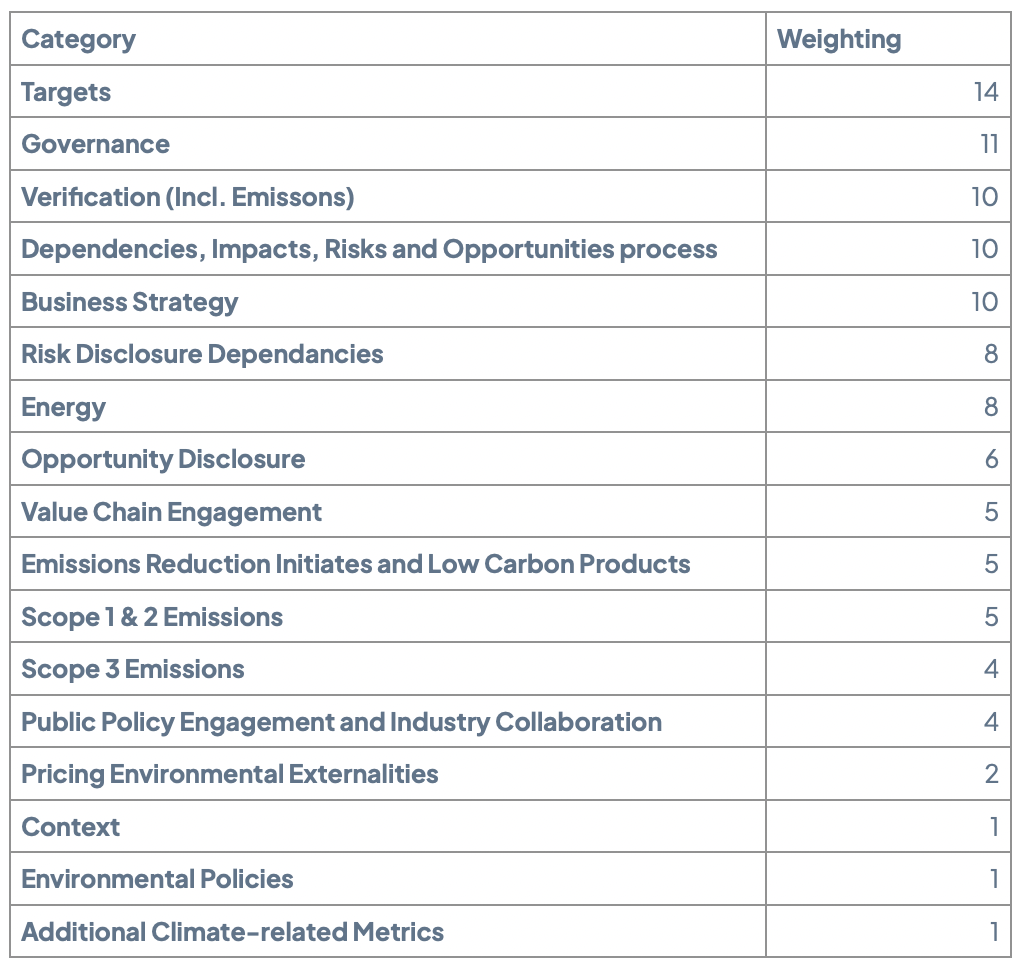
Responses to the questionnaire are scored by accredited scoring partners. Neither the CDP nor the scoring partners authenticate the information presented in the questionnaire and that is why independent verification is fundamental to ensuring trust in the voluntary disclosure programme.
5.0 Scoring levels
Organisations are assessed and scored across four levels, to show their progress on the road towards environmental stewardship. Each level has minimum requirements that need to be achieved before progression to the next stage.
- Disclosure(D-/D) This relates to the completeness of the questionnaire, with points rewarding the amount of data provided and its importance to users.
- Awareness (C-/C) Indicates how comprehensively an organisation has evaluated its environment risks and impacts.
- Management (B-/B) Points are awarded where there is evidence of good environmental management.
- Leadership (A-/A) This is a demonstration of best practice in the strategies employed, distinguishing a company as leaders in environmental management.
Box out: Strategies for improving your CDP score.
A score of B or above is considered a good score. A is the highest level and this recognises companies that meet the rigorous standards and are pioneering best practice and environmental responsibility.
To achieve an A score, companies disclosing to CDP must verify the environmental data they provide, and this process must be completed by an accredited third-party provider.
To qualify for the A-list companies must have:
- 100% of their Scope 1, Scope 2 emissions and 70% of their annual Scope 3 emissions independently verified according to CDP-recognised standards. Acceptable standards, such as ISO 14064, for measuring and quantifying greenhouse gas emissions are listed on the CDP website.
- Demonstrate robust governance and risk analysis.
- Demonstrate progress on science-based targets and emissions reduction along the entire value chain.
- A transition plan that is publicly available and is aligned with the Paris Agreement
6.0 Achieving the best score
CDP should not be considered a ‘tick box’ exercise, but instead part of the corporate strategy to achieve Net Zero. Therefore, the processes and procedures put into place will also improve the company’s resilience while reducing impacts.
Drawing on Carbonology’s experience as a standards and verification expert we would like to offer the following advice:
Set relevant and ambitious science-based targets – the Climate commitment is a global initiative that aims to halve greenhouse gas (GHG) emissions by 2030 and achieve net-zero before 2050. ISO 1400 will help set ambitious targets that are appropriate for your organisation.
Analyse your risks – measuring impacts and dependencies is a good first step. Invest in precise methods to measure your GHG emissions and climate impacts. (There are tools available on the CDP SME Climate hub). ISO 14064 is compatible with CDP, so you will have the information available for answering the questionnaire and can use this to build an robust environmental management system.
Engage the board – create a clear strategy for managing climate-related risks and opportunities and gain the support and leadership from the board. This will ensure that the strategy is aligned with business and financial planning and nurture a culture of sustainability throughout the organisation.
Increase transparency – Answer as fully as possible but don’t be afraid to say no, to avoid further questions where you don’t have the data to back up your responses. Banks often ask for the CDP questionnaire as part of the application process for Sustainable Finance and full disclosure is well regarded.
Learn from benchmarking - comparison of performance against peers may reveal inefficiencies and wasted resources and indicate areas for improvement. Taking these insights and implementing strategies to increase performance provides evidence of leadership.
Increase your influence – integrating sustainability within the business strategy and engage with others in the value chain to help improve their performance will take you to the leadership level. Reporting on Scope 3 emissions generated by the supply chains is one of the best ways to upgrade your score as around 90% of an organisation’s emissions are Scope 3. It is likely that 20% of your suppliers produce the most GHG emissions so address them first.
Take advice and gain verification – the CDP methodology and scoring changes each year so make sure you have the most relevant advice and gain a second pair of eyes through independent verification. Verification bodies vary in size and scope, so you need to check there is a good fit with your organisation and aspirations and their competence has been independently assessed. The CDP has a stringent due diligence process for selecting its own authorised verifiers, so that is a good place to start.
Challenges of reporting to CDP
Collating data from disparate sources, creating appropriate targets and preparing action plans for climate action, is a collaborative venture that needs the leadership of the board and the support of champions throughout the organisation. So, companies that don’t embrace sustainability as core to business resilience are unlikely to rank much beyond D ‘Disclosure’ on CDP.
Common challenges include:
- Weak data strategy – carbon accounting is a dynamic field with rapidly evolving standards and regulations. The environmental management system needs to cope with many data points and to be able to update them regularly.
- Lack of capability – carbon reporting is a recent development so there may not be systems in place to collect the right data. Knowledge of standards is needed to analyse and present it in a meaningful way.
- Limited knowledge of best practice – the environmental standards are designed to support best practice, often companies starting from scratch or with limited understanding of carbon accounting are not gaining the detail needed for CDP.
Next steps – working with Carbonology
Find out if you are ready for verification with a free readiness review (link).
About Carbonology
Carbonology is a CDP accredited verification solutions provider. Its Carbonologists are experts in carbon standards and provide consultancy and training to enable clients to improve the quality and efficiency of their carbon reporting and to build capability within their in-house teams.
When it comes to independent verification and assurance, against a range of GHG standards including ISO 14064 and Net Zero transition (ISO14068), Carbonology’s in depth knowledge and friendly approach is highly respected and trusted by its clients, also by the financial and legal sectors, and leading disclosure platforms.
About the Author: Melanie Blackmore, entrepreneur, CEO, podcaster, and author
Melanie Blackmore is the founder and CEO of Carbonology, a leading specialist in carbon standards.
Through consultancy and independent verification, Carbonology helps companies embrace the opportunities of the low-carbon economy, by substantiating their environmental credentials for stakeholders including regulators, customers, banks, and investors. It is a CDP verification solutions provider.
Melanie is a passionate advocate for – and communicator about – sustainability. She has led award-winning environmental projects, created a popular podcast 'The ISO Show' and hosts a webinar series featuring leaders in sustainability. She is currently conducting interviews with captains of industry as part of her Masters by Research (MRes) to deepen the understanding of the role of carbon standards in supporting businesses to achieve Net Zero.
Webinar Speakers:
How to improve your rating on CDP
This Webinar has passed


The ISO Show
Subscribe to keep up-to-date with all our latest episodes:





Make an enquiry
Request a quote for any or all of our Carbonology® Services

